A case interview is essentially a mini consulting project. The interviewer will present you with a hypothetical business problem (often based on a real project from their firm) and ask you to solve it in real time. These problems reflect the types of challenges consultants face in their day-to-day work, such as determining why a company's profits are declining or evaluating whether a client should enter a new market.
Unlike most interview questions, the case interview is intended to be a conversation. As you complete the case, you'll engage with your interviewer, ask questions, brainstorm together, and ultimately reach a final conclusion.
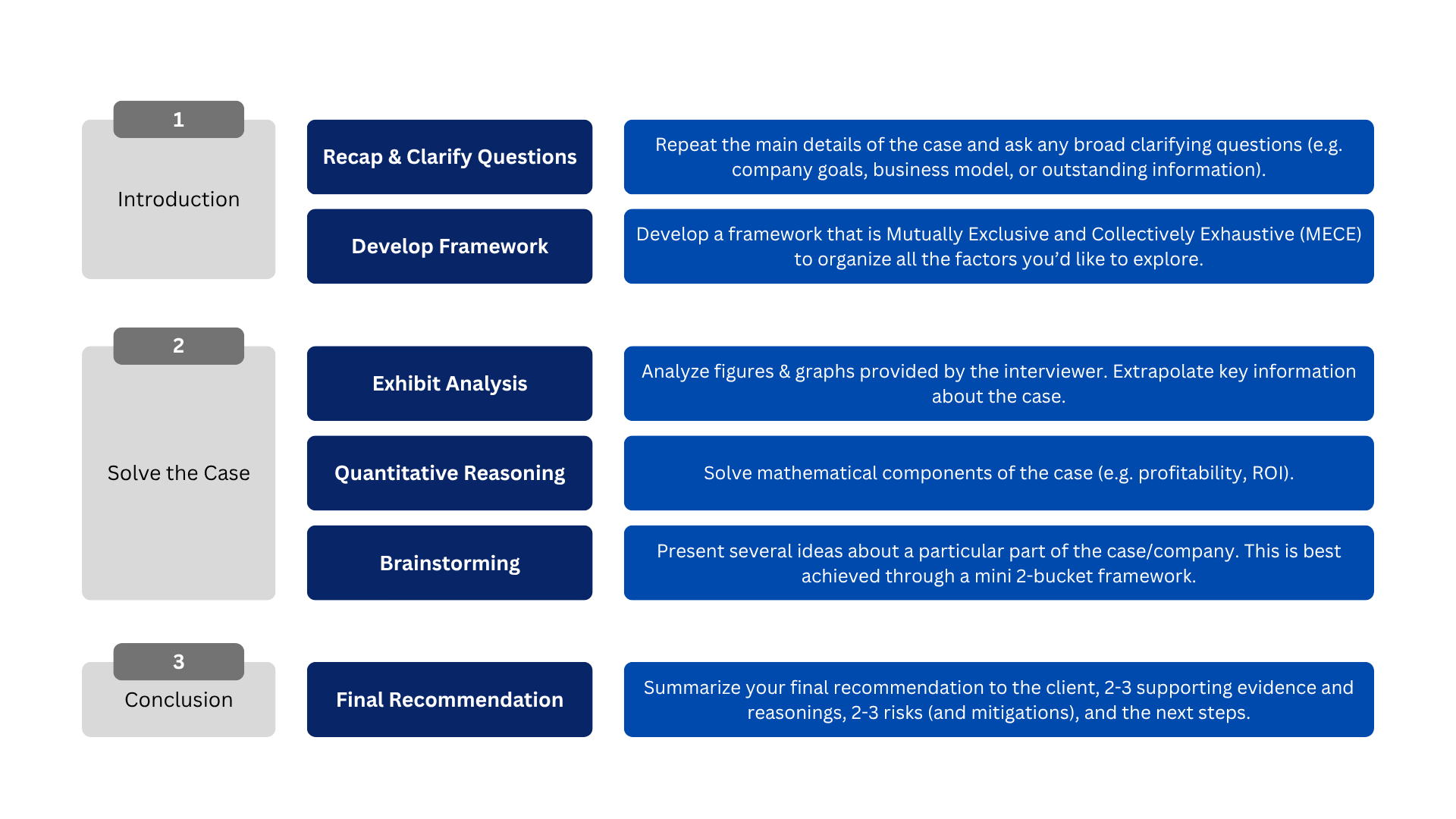
This can be confusing at first, especially if this is your first time exploring consulting. Before going any further, we'd recommend watching an example on YouTube so you can get a better understanding of how a case interview looks in practice. Here is a great example from Bain & Company. As you watch, keep in mind that each consulting firm has a slightly different version of case interviews that they use, which we'll dive into more later in this guide. Below is a helpful graphic that describes the typical "flow" of a case interview.
Types of Case Interviews
While all cases involve structured thinking and analysis, the business problem at the center of each case can vary widely. Some cases focus on growth opportunities, while others are centered around crisis management or operational challenges.
One of the most useful pieces of advice I received during the recruiting process was to research your interviewer ahead of time whenever possible. If you know you're speaking with a McKinsey partner who works in the private equity practice, for example, you can often anticipate a market analysis or M&A-style case. If you're interviewing at a boutique that specializes in the events industry, you might expect something tied to customer acquisition or pricing in that space.
While this approach is not always foolproof, in my experience it helped predict the type of case with a fairly high degree of accuracy. In the next section, we will take a closer look at how different firms approach case interviews, including examples from MBB, the Big Four, and several boutique consultancies. For now, it is helpful to get familiar with the most common case types across firms.
Profitability: The client is experiencing lower profits than expected. Your job is to identify the root cause and propose ways to restore profitability.
Market Entry: A company is considering entering a new market, whether geographic or product-based. You must evaluate the attractiveness of the market and how the client should enter.
Mergers and Acquisitions (M&A): The client is thinking about acquiring another company or has been approached with an acquisition offer. The case involves assessing strategic fit, financial logic, and potential risks.
New Product Launch: The client wants to develop and launch a new product. Your role is to evaluate whether the opportunity is worth pursuing and what a successful go-to-market strategy would look like.
Pricing Strategy: You are asked to determine how a product or service should be priced. This could involve assessing customer willingness to pay, competitor pricing, or the impact on revenue and profit.
Growth Strategy: The client wants to grow. You need to identify viable paths for growth, which may include market expansion, product development, partnerships, or acquisitions.
Competitive Response: A competitor has taken a bold move – launched a new product, slashed prices, or entered the market. You are tasked with recommending how your client should respond.
Cost Reduction: The client needs to reduce costs to improve profitability or survive a downturn. You must identify opportunities to cut spending without harming core operations.
Operational Improvement: The client is not performing efficiently. You need to uncover operational bottlenecks and propose changes to improve productivity or service quality.
Turnaround Strategy: The client is facing major financial or market challenges and is at risk of failure. Your task is to identify urgent issues and recommend a path forward to stabilize the business.
While this list isn't exhaustive of every case type, it covers the most common ones you'll encounter. Each type of case requires a slightly different mindset and approach. Some are more quantitative, while others lean heavily on qualitative judgment. By understanding these types and practicing across all categories, you will be better equipped to handle whatever is thrown your way.
Next: Company Styles
Although the structure and goals of case interviews are generally consistent, the format and expectations can vary significantly from one consulting firm to another. In the next section, we will dive into the specific casing styles used by McKinsey, BCG, and Bain (the MBB), as well as Big 4 and Boutique firms. You will learn how to tailor your approach based on each firm's process and how to adjust your preparation to align with what each one values most.
Explore our growing library of free resources designed to help you break into consulting with confidence. Whether you're prepping for interviews or polishing your resume, we’ve got you covered.
📄 50+ MBB Practice Cases – Practice using real cases that mimic the real interview.
📝 Resume + cover letter guides – Stand out on paper so you can land an interview.
💬 Fit/behavioral question bank – Get ready for the “Why consulting?” moment.
📊 Offer and salary data – Know your worth.
🗓️ Recruiting timeline tracker – Stay one step ahead of the rest.
📚 Casing drills – Math, brainstorming, frameworks. Drill until you're a master.