












CafeNova
While many things are contributing to the profitability difference between the US and Europe, the CEO would like OC&C to focus first on Labor Costs. Given the following exhibits, what factors are contributing to the higher costs in the US, and what are some ways that the company can fill these gaps in the US to return to profitability?
Case Exhibit
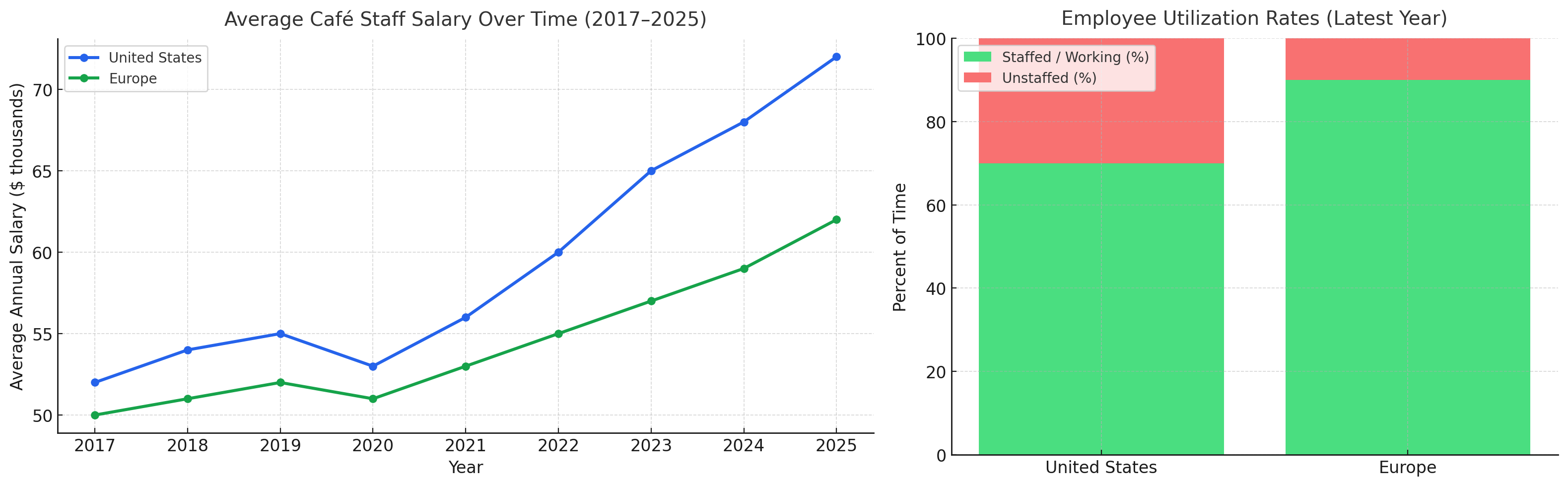
Looking at these exhibits, the clearest explanation for CaféNova’s higher U.S. labor costs lies in both rising wages and lower employee utilization. The salary trend shows that pay in the U.S. has increased much faster than in Europe since 2020, likely driven by inflationary wage pressure, labor shortages in service industries, and competition for talent from larger chains. Meanwhile, utilization data reveals that U.S. staff are only productive about 70% of the time compared to roughly 90% in Europe, meaning CaféNova is paying more per employee while getting less output. This combination of higher wages and underutilization directly explains much of the profitability gap between the two markets.
To narrow this gap, the company should focus on improving labor efficiency rather than simply cutting headcount. Key actions could include optimizing shift scheduling to better align staffing with demand, improving retention and training to reduce turnover-related downtime, and introducing process or technology enhancements, such as mobile ordering or partial self-service, to increase throughput per employee. Closing these productivity gaps would allow CaféNova to maintain competitive wages while restoring a more sustainable cost-to-output ratio in its U.S. operations.