











Dead Code
The McKinsey team pulled engineering headcount and cost data across Vertex's organic business and the four acquired entities. The CFO has been unable to pinpoint whether the issue is headcount, compensation, or something else. Take a look at Exhibit 1 and walk through what you see.
Case Exhibit
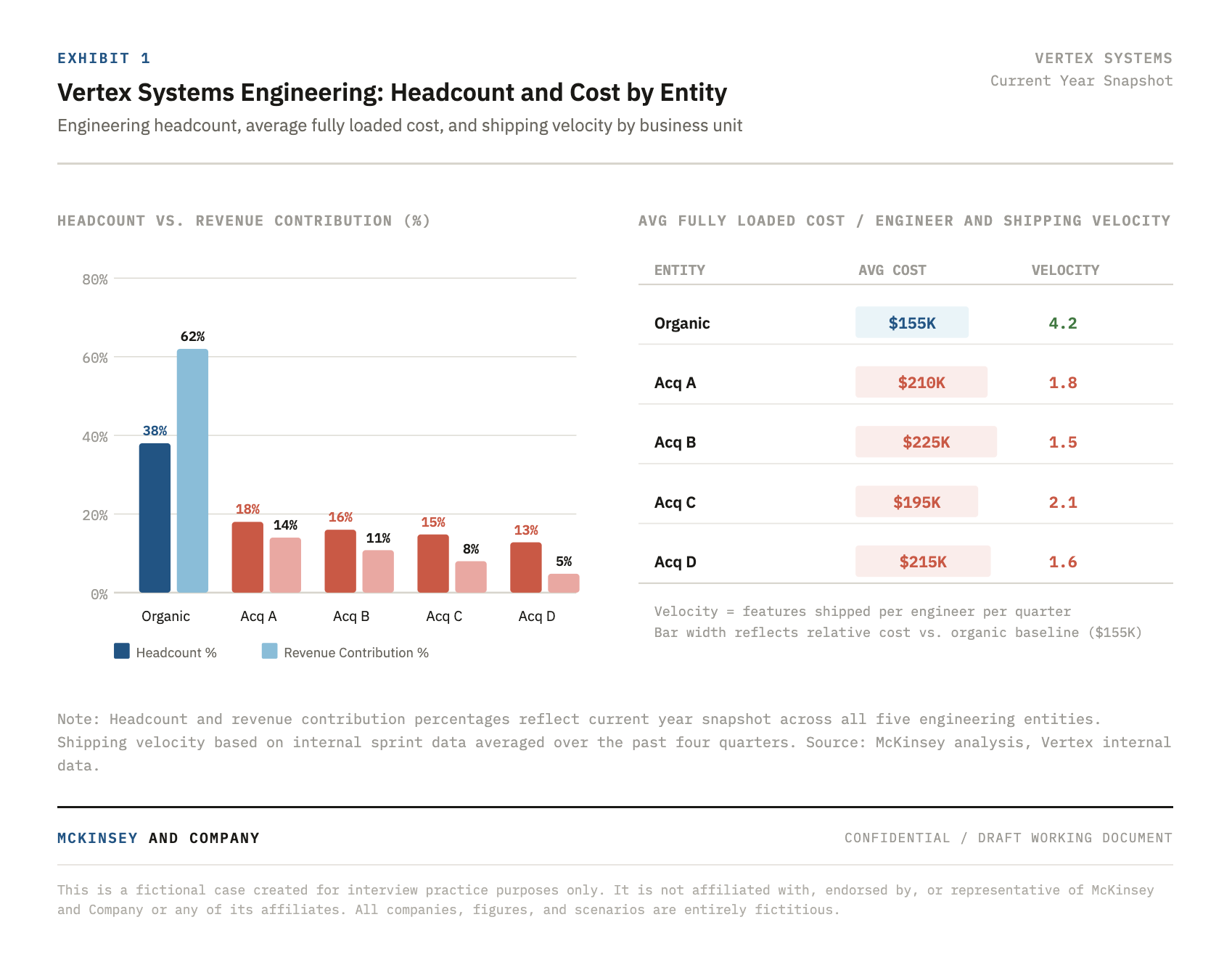
The exhibit reveals that the headcount problem is concentrated almost entirely in the acquired entities rather than the organic business. Vertex's organic engineering team has grown roughly in line with revenue over the three-year period. The four acquisitions, however, have added significantly more engineering headcount than their revenue contribution would justify, and critically, their average fully loaded cost per engineer is materially higher than the organic team, reflecting the fact that three of the four acquisitions were based in high-cost geographies.
The second finding worth flagging is that despite the higher headcount and cost, the acquired teams are producing disproportionately less in terms of shipping velocity (features released per engineer per quarter), suggesting the coordination overhead of running four semi-independent engineering organizations is creating significant efficiency loss.
The implication is that this is not primarily a compensation problem to be solved through pay cuts, and not a headcount problem to be solved through blanket layoffs. It is an organizational structure problem. The cost is high because Vertex is running what is effectively five separate engineering organizations with duplicated leadership, tooling, and infrastructure. The fix is consolidation, not reduction.